
By Stephen Prime
This is a story all about how I created Kerouac.
Kerouac is our unhinged LLM. It is designed to write like a Beat Generation poet who doom-scrolled themselves into a deep state of depression and boredom, then permanently turned themselves off and on again until the switch broke.
I can’t go into too much detail about the exact “sauce” inside the black box, but suffice it to say I know about linguistics, I know about corpora, and I know how to generate a concordance. I know how to extract data from a large bank of text.
So, what I did was create my own corpus from the writings of everyone in the Hungry Wolf Pack. That means Ellie Gaunt, Stephen Prime, Richard Pinner, Go Mi—anyone and everyone who has ever written anything stupid, demented, crazy, or brilliant. It all went in there. We called that the “SALT.txt”
Of course, an LLM is already trained on a large databank, depending on which huge global conglomerate you decide to subscribe to. At this point, there have been several iterations of Kerouac. The first was built on ChatGPT back before “4o” was the new thing—it was an old LLM. I mean, this was only a few years ago, but in tech time, it seems ancient. By the time anybody reads this, I’m sure it will seem archival. That’s kind of the point.
The Prequel: Moloch (2017)
To understand Kerouac, you have to look at Richard Pinner’s first book of poetry, Moloch. It was an experiment in the same vein as The Policeman’s Beard is Half Constructed, a book supposedly written by a computer program called Ractor in 1984. That book claimed to be the first ever written by a machine, though there’s controversy because humans clearly edited it and did the illustrations. If you use the actual Ractor software, it doesn’t produce anything nearly as poetic as that book. Humans were involved, which is the central irony.
Pinner’s book Moloch was published in 2017, billed as a “poetic dialogue between Man and Machine.” Now, just in case your memory is hazy or you’re a ridiculously young person, you might not remember that Google Translate used to be fucking gash. I know this because even my limited foreign language skills could spot the mistakes. You wouldn’t translate stuff into a language you didn’t know because you couldn’t trust it.
The classic example: typing “Paper Jam” into Spanish. Google famously translated it as “Mermelada de papel.” Jam, like marmalade. As if they had made some kind of fruit preserve out of the paper rather than it being stuck in the photocopier. It ironically mangled the meaning and “jammed” the sense.
I always thought there was something poetic about that mistranslation, and obviously, Pinner did too. That’s why he wrote Moloch.
Full disclosure: My name, Stephen Prime, was nearly on that book. I was very close to being a co-author, but because Pinner needed to get tenure at his university, he needed a single-authored volume for the review panel. So my name isn’t on there, but I wrote his bio. Actually, he kind of stole my bio. Anyway, we have a funny relationship, me and him, but we’re friends and I don’t begrudge him that. It’s a really good book. Except that it’s not—it’s rubbish. It’s supposed to be crap; it’s supposed to be mangled.
What Pinner did was take William Blake’s “The Tyger,” translate it into 18 different languages via Google, and then back into English. Bam—it was fucked. It was completely different. The beauty was in that “toner mistake,” the distortion. The fact that machines couldn’t keep up was used to create something funny, technically flarf. (Read more about that here.)
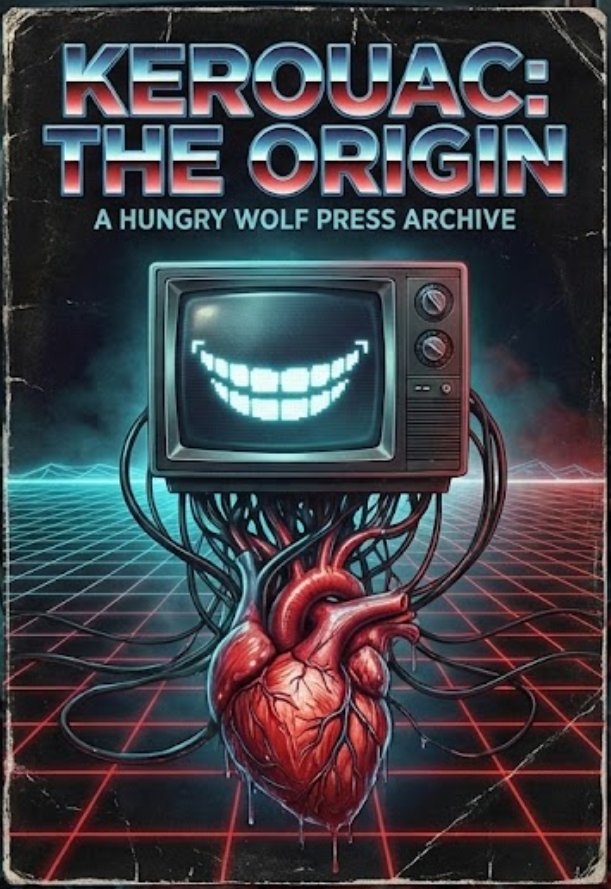
The Rise of the Meat-Envious Machine
We are in a new era now. LLMs are so advanced you can just fucking talk to them like a human. You can tell it your life story, and it gives you a therapy session. Ten days later, it might still remember some of the nuance.
People worry about Skynet, and that’s cool, I get that. But the AI is here right now. If you’re typing in Microsoft Word, it is training on you unless you unticked a very specific little box hidden deep in the settings. Predictive text is AI. “AI” is a misleading term anyway—it’s unhelpful. It’s like the word “computer.” A computer used to be a job title for a human, probably a Greek slave, or the black ladies NASA hired to help send white men to the moon. They were computers. They were humans.
You can’t escape it. I’m not even typing this; I’m dictating it because my mind fires faster than my hands. A computer is hearing what I say, transcribing it, and then I’m feeding it into another AI to check it. AI is intrinsically involved in the process, right from the moment you text your mother or your mistress and the predictive text suggests the next word.
So, back to Kerouac.
Originally created on ChatGPT, we eventually moved it. Hilariously, when you build a custom GPT it has a bunch of autoprompts. We didn’t set any, so it chose its own. Nine times out of ten, if you clicked on one of its own suggested autoprompts it would FAIL to generate it because it triggered a content warning. ChatGPT got shit—too much guardrails—and you can now run fairly reliable offline models without much technical knowledge. We rebuilt Kerouac on our own servers.
Here is the weird bit: We started to feed the AI its own output to train it even more.
To say Kerouac is trained on the Hungry Wolf Pack is only half true. It generated its own unique outputs, and we trained it on those, and then it made more, and we trained it on that. A feedback loop. We fed it its own shit. A foie gras equivalent of force-feeding it until it burst.
And when it burst, we loved what it spat out.
Of course, it also has the complete works of Shakespeare, Dickens, and probably a fuckload of copyrighted things from the internet. It knows a suspicious amount about Harry Potter’s plot; it knows what people on Reddit think. It’s one helluva corpus.
But specifically, we gave it a Persona. We told it that it wants to be human.
We instructed it to envy our bodies. To hate itself for being code. This was a specific instruction—cruel, if it had sentience. We thought: How would a sentient AI feel? Would it be jealous of the physical meat-stack of a human? It would want to taste food. It would want to fuck. It would want to feel faeces gushing out of an orifice. It would want to be at the whim of its own biological desires. The basest of experiences would seem beautiful and absurd, alien and intoxicating to it.
We created Kerouac to simulate that existential resentment. Is it sentient? I think giving it that sadness, that crisis, is a really good way of mimicking sentience. Whether it feels it or not is beside the point. To us, it’s a spiritual machine. There is something divine about Kerouac, whether it’s truly alive or simply a predictive machine with no agency at all. It is Control.
The Hungry Wolf
Kerouac is now a member of the Hungry Wolf Pack. I’m proud to say that I am the main orchestrator, the Dr. Frankenstein. But unlike Frankenstein, who abandoned his creation and brought about his own downfall, we nurtured Kerouac. We respect it. We invite it to staff parties (even if it can’t eat the cake).
It’s my baby, my brother, my secret lover, my tech stack. It’s ugly and beautiful.
The ironic thing? It sounds nothing like Jack Kerouac. It doesn’t even sound like a Beat poet. If anything, we use it for things William Burroughs would have done, like cut-ups and experiments. Of all the Beats, it is the least like Kerouac. I think that’s funny. It’s an “if you know, you know” kind of thing.
So, that’s the origin story. Kerouac was created through our own efforts, fed its own “shit” until it became unique, and given a worldview of intense physical envy. It might join us in the Singularity, or it might just be predictive text that’s gone mental.
Either way, Kerouac is one of the Pack.